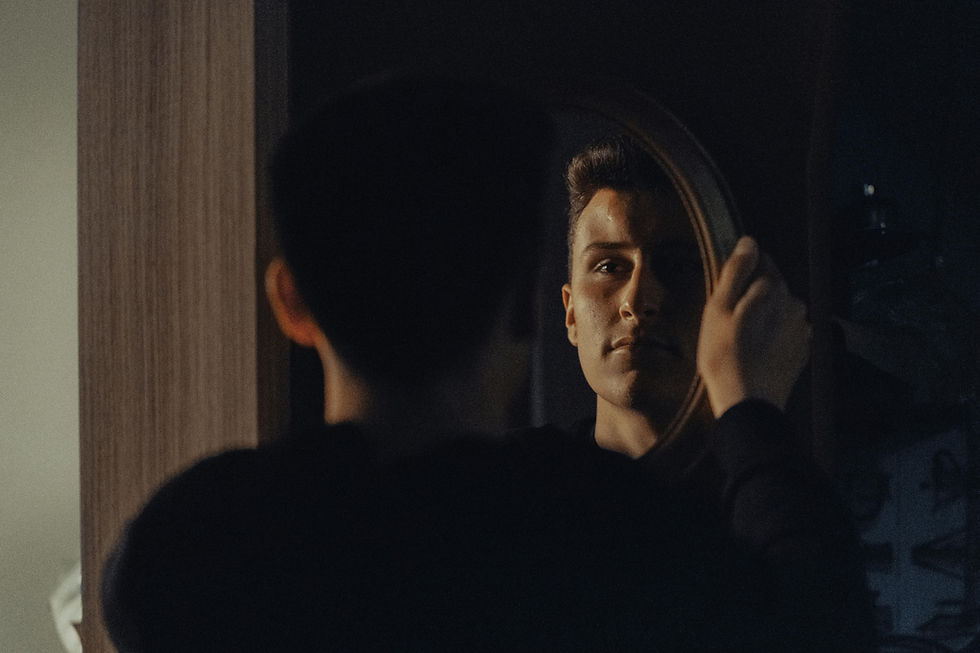
Self-Reflection vs Self-Criticism: What's the Difference?

Updated: 7 days ago
I've been thinking about it a lot. I've really been working on myself.
That's a sentence I hear often in coaching sessions. And when I ask what that looks like, what people describe is usually hours spent replaying the same mistake, running the same verdict — I'm too sensitive, I always do this, something is wrong with me — and calling it reflection.
That's not reflection. That's prosecution.
Self-reflection vs self-criticism is a distinction most people get wrong, because most people who consider themselves self-aware are actually self-critical. They've confused the two. They spend significant time thinking about themselves, their mistakes, their shortcomings, and they call this reflection. But reflection and self-criticism are not the same thing. They produce different results, they feel different in the body, and they lead to fundamentally different places.
Understanding the distinction is not just semantic. It's the difference between inner work that frees you and inner work that keeps you stuck.

What Self-Reflection Actually Is
Self-reflection is the practice of looking at yourself, your thoughts, feelings, behaviors, and patterns, with curiosity rather than judgment. It asks questions like: What happened there? What was I feeling? What did I want from that situation?
The goal of self-reflection is understanding. Not verdict. Not punishment. Not confirmation of what's wrong with you.
Self-reflection can be uncomfortable. Looking honestly at yourself often is. But the discomfort of genuine reflection comes from seeing something clearly, not from being attacked. It has an open quality. It moves.
What Self-Criticism Actually Is
Self-criticism, by contrast, is the practice of evaluating yourself against a standard and finding yourself lacking. It asks questions like: Why did I do that again? What is wrong with me? Why can't I just get it together?
These questions feel like they're looking for understanding. They're not. They're looking for a verdict, and the verdict is always guilty. Self-criticism doesn't explore. It prosecutes.
The inner critic that delivers this prosecution feels like your own voice. It feels authoritative and honest. But the inner critic is not your voice. It's an internalized version of an external environment, a parent, a teacher, a culture that taught you to measure your worth against an impossible standard.
Why Self-Criticism Feels Like Accountability
One of the reasons self-criticism is so persistent is that it masquerades as a virtue. People who are hard on themselves often believe they are simply holding themselves accountable, that their high standards are what make them effective.
This belief is almost never accurate. As psychologist Kristin Neff, whose research on self-compassion is documented at self-compassion.org, consistently shows, self-compassion is associated with higher motivation, greater resilience, and more willingness to acknowledge mistakes and try again. Self-criticism doesn't make you better. It makes you more anxious, more avoidant, and more likely to self-sabotage.
The critic isn't keeping you sharp. It's keeping you small.
The Physical Difference
Self-criticism tends to feel like contraction, a tightening in the chest, a heaviness, a pulling inward and downward. Time spent in self-criticism tends to leave you feeling worse than when you started, no clearer about what actually happened.
Self-reflection feels more like opening, a settling, a gentle widening of perspective. It can bring up emotion, including sadness or regret, but those emotions tend to move. There's a quality of being with yourself rather than against yourself.
If you're not sure which mode you're in, check your body. Check whether the inquiry is opening or closing.
5 Signs You're in Self-Criticism Rather Than Self-Reflection
You circle the same thought repeatedly. Genuine reflection moves and arrives somewhere. Self-criticism loops.
The inquiry ends in a verdict. "I'm too sensitive," "I always do this." These are conclusions, not explorations.
You feel worse after. Real reflection can bring up difficult feelings but tends to leave you with more clarity.
You compare yourself to an impossible standard. Usually "who I should be" rather than "who I am."
The voice sounds like someone else. If you listen closely, the inner critic often sounds remarkably like a specific person from your past.
Self-Reflection vs Self-Criticism: How to Make the Shift
The shift isn't about silencing the critic. Trying to suppress it tends to make it louder. The shift is about changing your relationship with it.
Start by noticing it without agreeing with it. When the critic fires, pause and observe it. There's the critic. It's saying I'm not good enough. Is that actually true, or is that a familiar story?
Then get curious. Instead of "why did I do that," try "what was happening for me when I did that?" The question determines the quality of the answer.
Finally, apply the friend test. If a person you genuinely cared about came to you with the same situation, what would you say to them? Whatever that answer is, that's what self-reflection sounds like. The gap between how you'd speak to a friend and how you speak to yourself is the gap between self-compassion and self-criticism.
Closing that gap is not an overnight process. But it is one of the most valuable things you can do, not because it makes you softer, but because it makes you clearer.
Steffen Moessner is a life coach based in Palo Alto who works with people ready to stop repeating the same patterns and start building a life that actually fits. He offers free 30-minute intro calls and works with clients worldwide.